
Advanced · Specialty course
Solo Diver
Solo Diver is advanced training for experienced divers who want to develop the planning, redundancy, awareness, and problem-solving skills needed to manage a dive without depending on immediate assistance from a buddy.
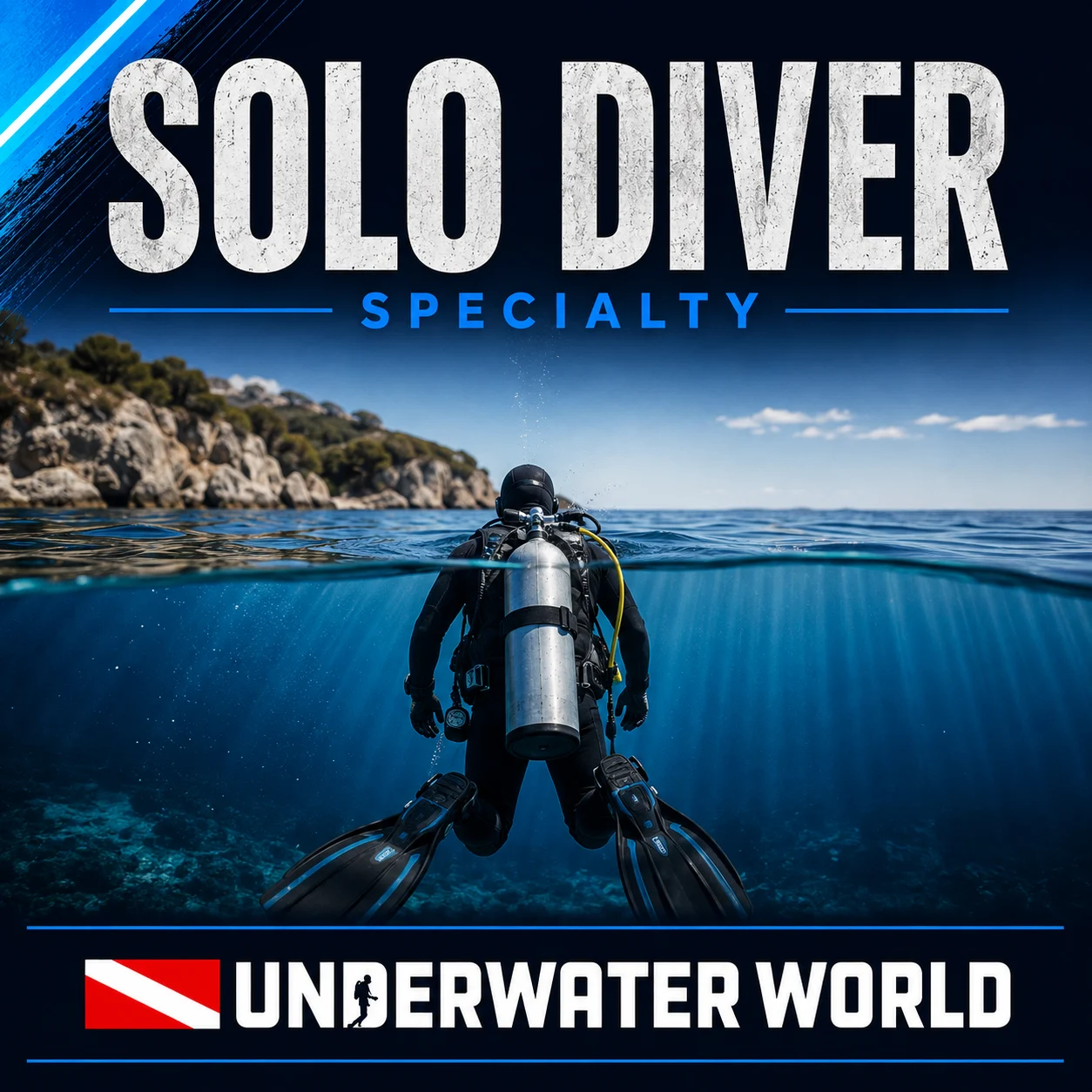
Develop True Self-Reliance Underwater
Solo Diver is advanced training for experienced divers who want to develop the planning, redundancy, awareness, and problem-solving skills needed to manage a dive without depending on immediate assistance from a buddy.
Course Information
What You'll Learn
Self-reliant diving requires additional planning, equipment, preparation, and personal responsibility beyond traditional buddy diving.
- Planning and conducting self-reliant dives
- Evaluating personal limits and when not to dive alone
- Gas planning based on individual consumption
- Redundant life-support equipment and configuration
- Navigation and situational awareness
- Emergency planning and problem management
- Surface signaling and emergency location procedures
- Managing equipment failures without immediate buddy assistance
In-Water Training
Underwater World expands the Solo Diver program to include three open-water training dives. These dives give you additional opportunities to apply self-reliant diving procedures while working under Instructor supervision.
Training includes dive planning, gas management, navigation, redundant-gas procedures, controlled ascents, SMB deployment, and simulated equipment problems.
You'll also demonstrate the ability to maintain appropriate buoyancy, trim, awareness, and control while managing problems independently.
Required Equipment
Solo diving requires redundancy and additional emergency equipment. Divers must arrive with the required equipment appropriate for the course and local diving conditions.
- Redundant breathing-gas supply
- Primary and backup dive lights
- Tank marker
- Backup mask
- Two line-cutting devices
- Audible signaling device
- Emergency location device
- Ascent reel with at least 300 feet of line
- Surface marker buoy with reflective material
- Lift bag rated for at least 50 pounds
- Finger spool
- Slate or wet notes
Your redundant breathing-gas system may be a properly configured pony cylinder or doubles with an isolation manifold, as appropriate for the course and approved by your Instructor.
Why Take Solo Diver?
You do not need to plan on regularly diving alone to benefit from this training. The same skills that support self-reliant diving can make you a stronger member of a buddy team.
Better gas planning, equipment redundancy, navigation, situational awareness, and independent problem-solving are useful skills whenever you are underwater.
Schedule
Available dates
Next dates to be announced
Sign up below for a one-time email with the next dates and pricing.
Get new dates by emailHelpful answers
Frequently asked questions
Do I need 100 logged dives?
Yes. You must provide proof of at least 100 logged dives and hold an Advanced Diver certification or accepted equivalent before beginning Solo Diver training.
Do I need to own redundant equipment?
Yes. Self-reliant diving depends on appropriate equipment redundancy. Divers must have the required redundant gas supply and other course equipment before completing the open-water training.
Do I have to plan on diving alone to take this course?
No. Many of the skills developed in Solo Diver training also strengthen traditional buddy diving by improving self-sufficiency, planning, awareness, and the ability to manage equipment problems independently.
Can I solo dive anywhere after certification?
No. Certification does not override the rules of a dive site, vessel, operator, or other applicable requirements. Divers must always follow the rules and procedures governing the location where they intend to dive.
Are the listed dates placeholders?
No. The dates shown for this course are the confirmed training dates.